PotWatch / How it works

How it works

The idea is simple: wait for the water to boil, then start the timer. Making a machine agree with you about what "boiling" means turned out to be the interesting part.

The physics

Water does not boil at 100 °C.

This is the fact everyone half-remembers from school and nobody accounts for in the kitchen. A liquid boils when its vapour pressure equals the pressure of the air pushing down on it. Change the air pressure and you change the boiling point.

100 °C is only correct at sea level, on an average day. Go up a mountain and there is less air above you, so water boils cooler. Even staying put, a passing weather system moves the boiling point by a few tenths of a degree.
Altitude
Water boils at
0 m — sea level
100.0 °C
500 m
98.3 °C
1 000 m
96.7 °C
1 500 m
95.0 °C
2 000 m
93.4 °C

This is why high-altitude cooking instructions exist, and why an egg takes longer in Denver than in Dublin: the water is simply not as hot, however furiously it bubbles.

Why a fixed threshold cannot work

A device that waits for 100 °C in a kitchen where water boils at 97.6 °C will wait forever — the temperature never arrives, because the water is already turning to steam. Set the threshold too low instead, and the countdown starts while the water is merely hot. Either way the food is wrong, and the failure is silent.

The correction

Measure the air, not just the water.

PotWatch carries a barometric pressure sensor alongside the temperature probe. Near 100 °C the relationship between pressure and boiling point is almost a straight line, and the slope comes out of the Clausius–Clapeyron relation at roughly 0.03 °C per hectopascal. So the device stores one calibrated reference point and slides it up and down as the weather moves:

boilPoint = calibratedTemperature + (currentPressure − calibratedPressure) × 0.03 clamped to the range 85…102 °C · pressure in hPa

The linear approximation is deliberately only trusted over a small range. Weather shifts pressure by perhaps ±30 hPa, which is well inside where the straight line holds. Altitude differences of kilometres are not — and they do not need to be, because that part is handled by calibration instead.

Calibrating means boiling a pot of water once, in your own kitchen, and telling the device the number it sees. From that moment the reference point is correct for your altitude, your pot and your particular sensor, and the barometer only has to handle the daily drift.

The threshold is yours to choose

Everything above describes finding the real boiling point, which is the obvious thing to want. But the calibration screen does not insist on it. What you are really setting is the temperature at which the countdown starts, anywhere between 85 and 102 °C, and there is a good argument for putting it lower.

Water does not jump from still to rolling. Well before a full boil it is already working hard — bubbles streaming off the base, the surface moving, plenty of heat entering the food. On the author's hob that point arrives near 88 °C, and it is a fine moment to start timing and turn the heat down. Gentler than a rolling boil, and for most things a better way to cook.

So read the feature as "start the timer when the water reaches this temperature". The true boiling point is the sensible default. A few degrees below it is a deliberate choice, not a mistake.

The measurement

One reading is never enough.

The probe is a DS18B20 — a digital sensor that does its own analogue-to-digital conversion and sends the result down a single wire, so there is no analogue signal to pick up noise on the way to the microcontroller. Resolution is set to twelve bits, about 0.06 °C, and it is read once per second.

Even so, a single reading is a bad basis for a decision. Water near a boil is a violent, uneven place: bubbles collapse against the probe, cold spots circulate, steam wraps the sleeve, and someone stirs the pot. Any of these can push one sample across the threshold.

So PotWatch requires five consecutive readings at or above the boiling point before it accepts the result. One reading below and the count resets to zero. In practice this costs about five seconds of delay and removes essentially every false start.

1 s
between samples
0.06°C
resolution, 12-bit
5
confirmations required
0.3°C
tolerance below the computed boil point
The sequence

What the device is doing, moment by moment.

  1. Menu. You choose a preset. The probe is not even being read yet — there is nothing to measure, and not reading saves power.
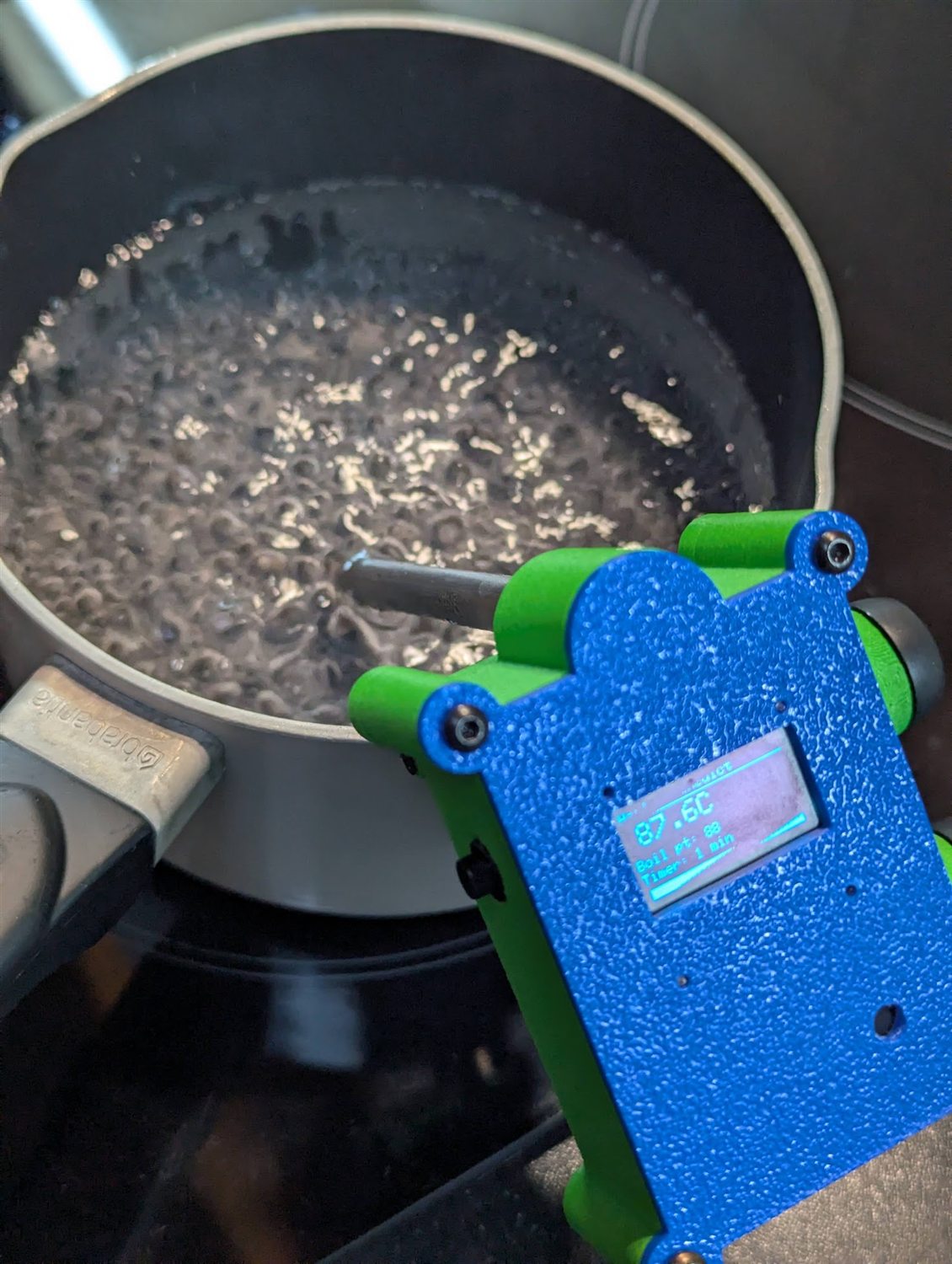
  2. Waiting for the boil. The screen shows live temperature, the calculated boiling point for right now, and a progress bar. Every second another sample arrives.
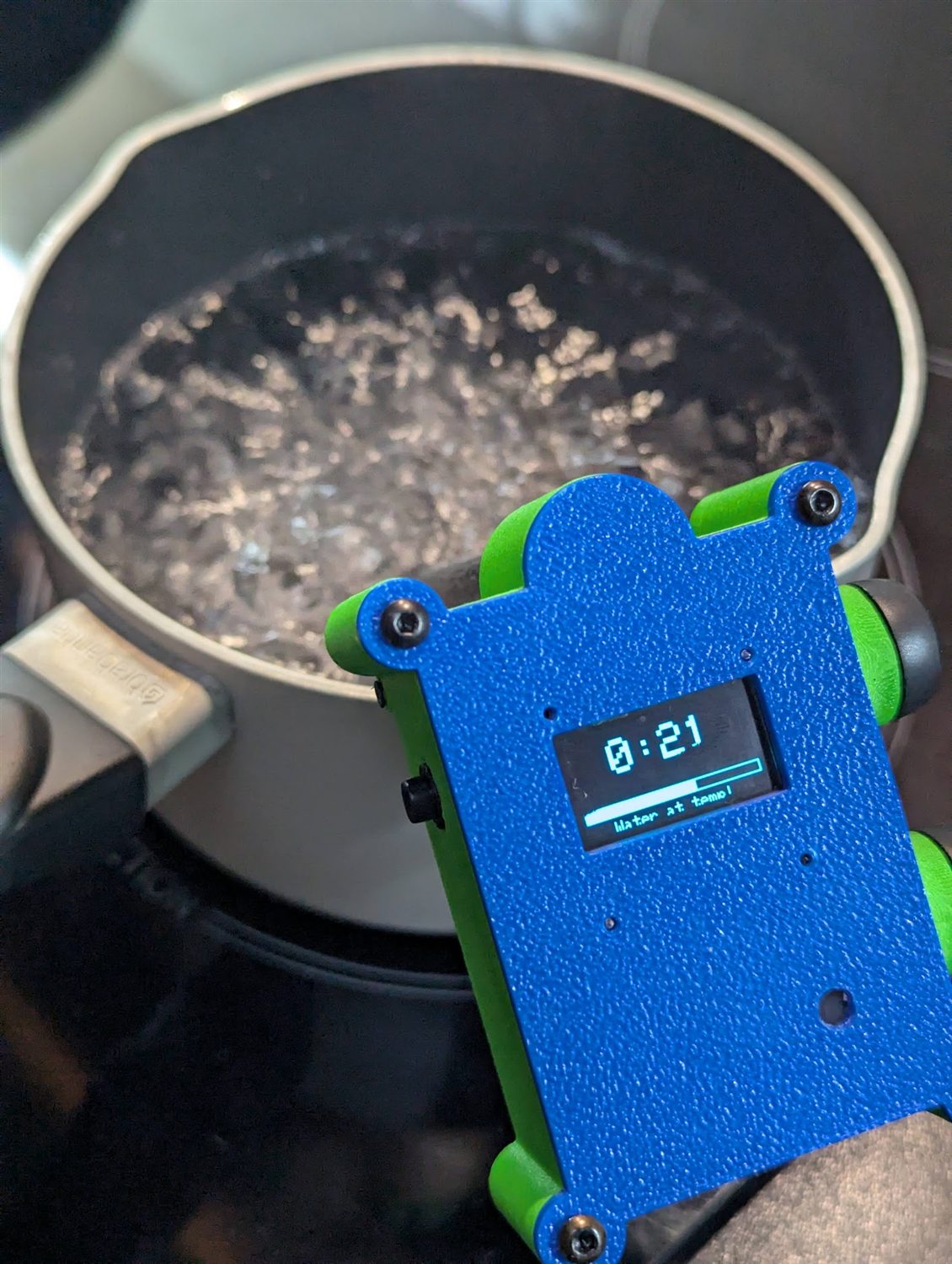
  3. Boil confirmed. Five samples in a row have cleared the threshold. Three beeps, and the countdown begins — this is the moment the whole device exists for.
  4. Counting down. Time remaining, a progress bar, and the temperature still being watched in the background in case the pot runs dry.
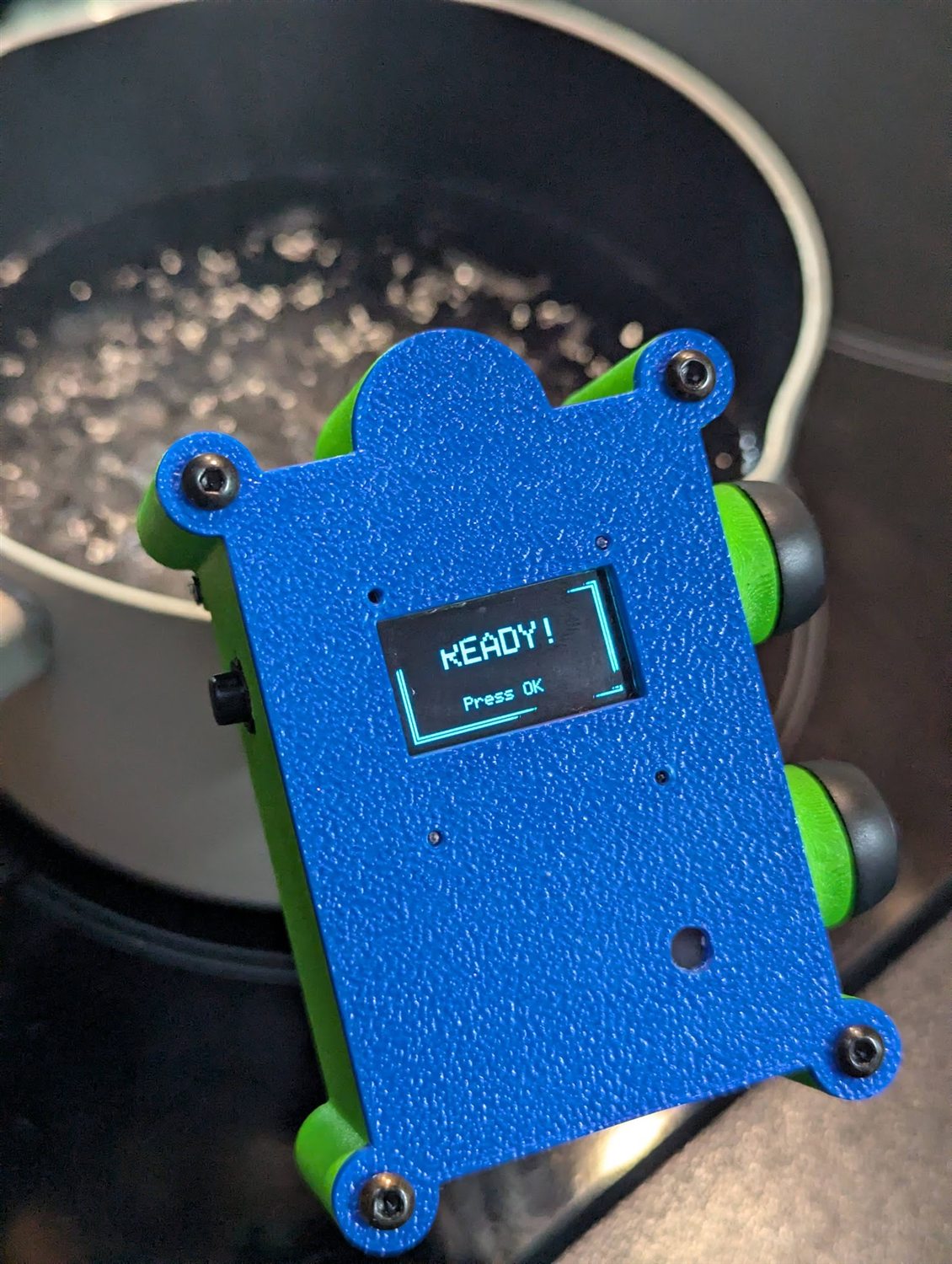
  5. Ready. The screen flashes and the buzzer repeats until acknowledged. Pressing OK stops it — and so does simply lifting the probe out of the water, because the temperature drop is unambiguous.
PotWatch clipped to a pot of heating water, its screen reading 87.6 degrees C with a boil point of 88 and a one-minute timer
Waiting87.6 °C, four tenths short of the 88 °C this device is set to trigger at. The water is already working, but the countdown has not started.
The same device counting down from twenty-one seconds, captioned Water at temp, over a pot at a full rolling boil
Counting downFive confirmations later the boil is accepted and the countdown runs. "Water at temp!" is the device saying the timer now means something.
The device showing READY! and Press OK beside the boiling pot
ReadyTime is up. The screen flashes and the buzzer keeps calling until you press OK — or simply lift the probe out.

// photographed on an induction hob, one minute of Benedict, start to finish

When things go wrong

Three failures worth designing for.

DRY POT

The water boiled away

Once the water is gone the probe temperature climbs past anything water can reach. Four consecutive samples above 105 °C and PotWatch stops the countdown and raises a NO WATER alarm.

BAD PROBE

The sensor stopped answering

A disconnected DS18B20 returns a specific error value, and an unconfigured one returns exactly 85.0 °C. Both are recognised as meaningless. After five bad samples the screen says CHECK PROBE and shows dashes rather than inventing a number.

PROBE OUT

You lifted it out

During the ready alarm, a temperature well below boiling means the probe is in the air. The device treats that as acknowledgement, silences itself and returns to the menu — which is the gesture you were making anyway.

Silence is the worst failure mode

The principle behind all three: a device that quietly does nothing is worse than one that complains. If PotWatch cannot measure, it says so. If the situation is dangerous, it makes noise. The only thing it will never do is sit there pretending everything is fine.